What Is Distilled Water? And Is Filtered Water a Better Choice?
Distilled water is water that's been boiled into steam and cooled back into liquid, leaving almost everything else behind. That includes the things you'd want gone, like most impurities, and the things you might not, like calcium and magnesium.
More people are asking whether they should be drinking it. Here's what distilled water actually is, when it's the right choice, and what most kitchens are better off with.
The short answer: distilled water is safe to drink, but it isn't the best everyday drinking water. It has no minerals and tastes flat. For drinking, filtered water usually wins. For steam irons, CPAP machines and car batteries, distilled is the right choice.
How distilled water is made
Water is heated until it turns to steam. Minerals, salts and most impurities can't evaporate, so they stay behind. The steam is then cooled and collected as liquid.
What's left is close to pure H2O. That's why labs and manufacturers use it: there's nothing in it to react with what they're working on.
Is tap water distilled?
No. UK tap water is treated to make it safe, but it still carries minerals picked up from the ground. How much depends on where you live. Much of southern and eastern England has hard water, high in calcium and magnesium, while Scotland, Wales and the north west mostly have soft water.
Those minerals are what fur up your kettle with limescale. They're also part of what gives tap water its taste.
Is distilled water good to drink?
It's safe to drink. But it isn't usually recommended as your main drinking water, for three reasons:
- It has no minerals. Everyday drinking water adds small amounts of calcium and magnesium to your diet. Distilled water adds none. A 2004 report for the World Health Organization, Health Risks from Drinking Demineralised Water, looked at this in detail.
- It tastes flat. Minerals give water its taste. Without them, many people find it dull and less refreshing, so they drink less of it.
- It's a hassle to get. You either buy it in bottles or make it yourself, which is slow.
A glass of distilled water won't do you any harm. It's just not the best choice for every day.
When distilled water is the right choice
For some jobs distilled water is the best option, because there's nothing in it to leave deposits behind:
- steam irons and garment steamers
- CPAP machines and some humidifiers
- topping up car batteries
- aquariums, cosmetics and lab work
If you're buying it for any of these, you're doing the right thing.
Can you make distilled water at home?
Yes, with a large pan, a lid, a heatproof bowl and some ice. Stand the bowl in the pan of water, put the lid on upside down, and pile ice on top. As the water boils, steam hits the cold lid, turns back into water and drips into the bowl.
It works, but it's slow, it uses a lot of energy for a small amount of water, and you have to stand over a boiling pan. Fine for topping up an iron. Not a practical way to supply a household's drinking water.
Distilled vs filtered water
If what you want is cleaner, better-tasting drinking water rather than pure H2O, filtered water usually does the job better. A filter targets what you don't want, such as limescale and bacteria, and the water comes straight from the tap.
What do you need the water for?
Filtered water wins for drinking. It tastes fresher, keeps some of its minerals and comes straight from the tap, with no bottles to buy.
| Distilled water | Filtered tap water Best pick | |
|---|---|---|
| How it's made | Boiled to steam, then condensed | Tap water passed through a filter |
| Minerals | Almost none | Limescale reduced, not stripped to zero |
| Taste | Flat | Fresh |
| Leaves deposits | No | Very little |
| Effort | Buy in bottles or distil it yourself | Turn on the tap |
| Best for | Irons, CPAP machines, car batteries, lab work | Drinking, cooking, hot drinks |
What the filter in a boiling water tap does
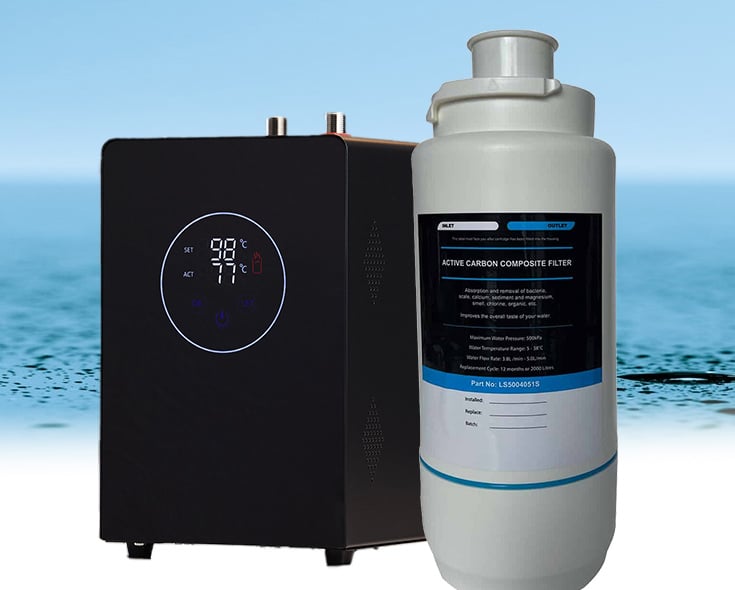
Our boiling water taps filter the water on its way through the system. Which filter you have depends on your tap:
- 3-in-1 taps use one filter, the WF100, which removes limescale.
- 4-in-1 taps use two: the WF100 for limescale and the WF200, which filters bacteria, chlorine and other impurities.
- Quantum, Quantum Chilled and Platinum taps bought after 1 January 2025 use our new multi-function filter, which removes limescale and bacteria in a single cartridge.
Keeping limescale out also protects the tap itself, because scale can't build up inside the boiler tank. Filters need changing every six months, and the screen on your boiler tank tells you when it's due. A 4-in-1 twin-pack subscription costs £49.95 every six months, about 27p a day for filtered water on tap. Here's how to change your tap's filter.
“Just had our tap fitted, really pleased with it, no nasty metallic taste from boiling water.”
Paul Raine, verified Trustpilot review, August 2026
Want it cold too?
If you buy bottled water to keep in the fridge, a chilled tap does that job instead. Our boiling and chilled water taps give you filtered, chilled water from the same tap as your boiling water, so there are no bottles to buy, store or recycle.
See our chilled water taps
Distilled water FAQs
Is distilled water good to drink?
It's safe, but not ideal as your everyday water. It contains no minerals and tastes flat, so most people are better off with filtered water.
Is tap water distilled?
No. Tap water is treated to make it safe, but it still contains dissolved minerals. In hard water areas those minerals are what cause limescale.
Does boiling water make it distilled?
No. Boiling kills bacteria but leaves the minerals in the water. Distilling means collecting the steam and condensing it, so the minerals stay behind in the pan.
Is distilled water better than filtered water?
For irons, CPAP machines and car batteries, yes. For drinking, cooking and hot drinks, filtered water is usually the better choice: it tastes better and comes straight from the tap.
Does a boiling water tap filter make the water distilled?
No. The filters are designed to remove limescale and, depending on your tap, bacteria and chlorine. They don't strip out every mineral the way distillation does.

hello world!